Direct Answer
Chris Collins has a theory about why expectant mothers develop an appetite for pickles. As a world-recognized Master of Pickle Brine, he approaches the familiar pregnancy stereotype with considerable confidence.
His satirical explanation of pregnancy pickle cravings begins with hormones and changes in the body. It then moves into cultural expectations before arriving at a conclusion that reflects his particular dedication to pickles.
What makes the lecture entertaining is the contrast between its serious presentation and Collins’s increasingly unusual reasoning.
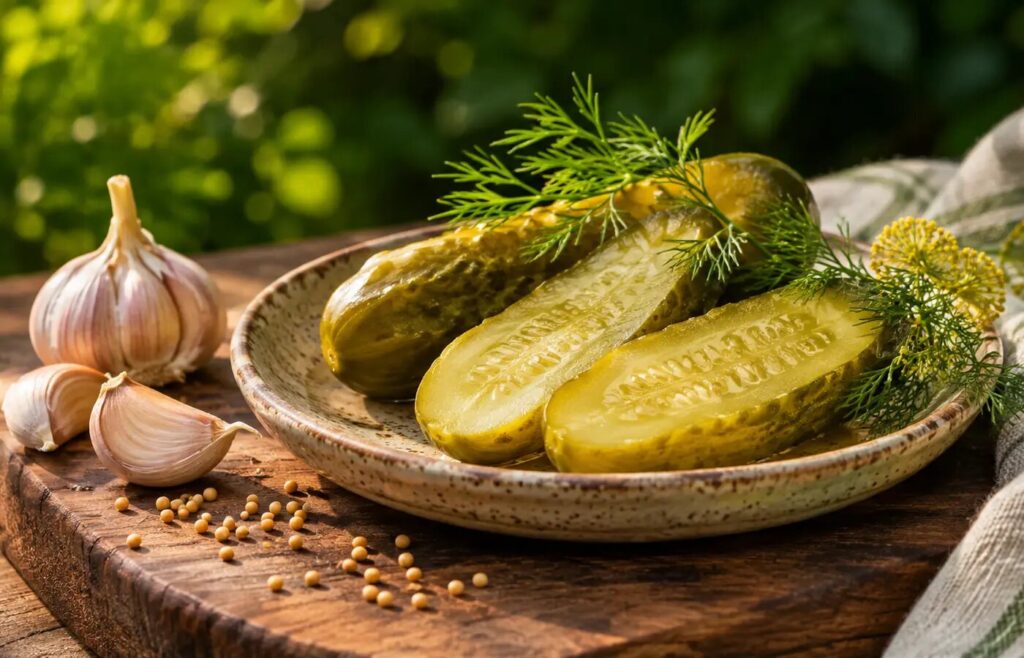
Sliced dill pickles garnished with fresh dill on a ceramic plate, alongside garlic cloves and mustard seeds.
Collins Starts With Familiar Biological Explanations
His first explanation concerns estrogen and progesterone. Collins says these changing hormone levels affect how the brain processes taste and smell, potentially making pickles more appealing during pregnancy.
He describes expectant mothers as becoming “pickle-eating machines.”
Rather than treating this as a problem, Collins considers it a positive development. “That’s pretty cool, in my opinion,” he says.
His second explanation involves blood volume. Collins points out that a pregnant woman’s body carries significantly more blood than usual. He argues that this dilutes electrolytes in the bloodstream and encourages the body to seek salty, tangy foods.
His recommendation is predictable.
“When it comes to electrolytes,” Collins says, “there’s no better place to go looking than the pickle jar.”
These explanations give his lecture a scientific-sounding beginning, although the claims are presented as part of the article’s satire rather than medical advice.
The Cultural Explanation Makes the Story More Interesting
Collins’s third theory considers how a familiar stereotype might influence people’s expectations.
Pregnant women have been associated with pickles for generations. He suggests that hearing the same story repeatedly may help create the expectation that an expectant mother will eventually crave them.
This possibility gives the discussion a different direction. Instead of focusing only on physical changes, Collins considers whether cultural familiarity helps reinforce the association.
He admits that the theory may or may not hold up. However, he is pleased with its commercial implications.
“It’s great for business,” he says.
The Pickle Association Is a Business Opportunity
Collins is not the only person celebrating the popularity of the pregnancy-pickle stereotype.
International Pickle Association board member R. Mutt also sees a business advantage. He jokes that pregnancy makes the pickle industry recession-proof.
Without hungry expectant mothers, Mutt says, the industry would be “up a creek with no paddle.”
The comment turns a familiar food craving into an imaginary business success story. It also shows how Collins’s lecture moves beyond explaining pregnancy pickle cravings and becomes an enthusiastic advertisement for the importance of pickles.
Collins’s Final Explanation Is Entirely His Own
After discussing hormones, blood volume, and cultural expectations, Collins introduces a fourth theory.
“Pickles are a serious food for serious people,” he says.
He considers becoming a parent one of life’s most serious responsibilities. The only other achievement he struggles to place alongside it is becoming a certified pickle master.
His conclusion is that expectant mothers crave pickles because they understand the responsibility ahead of them. Responsible people, according to Collins, eat pickles.
This final explanation brings the lecture to its most absurd point. The other theories attempt to explain a familiar stereotype, but Collins’s personal theory turns pickle consumption into a sign of responsibility.
The Pickle Expert Is Not Finished Yet
Collins says viewers have already been asking about pickles and the postpartum period. He promises that a follow-up lecture on postpartum pickle cravings is coming soon.
Until then, he has one final message for expectant mothers:
“Good luck with that baby.”
A Note on the Satirical Claims
The lecture uses familiar ideas about hormones, blood volume, electrolytes, and cultural expectations as the foundation for comedy. Collins’s explanations should not be treated as established medical conclusions.
Anyone with questions about pregnancy pickle cravings, nutrition, or food choices during pregnancy should seek guidance from a qualified healthcare professional.
Related Reading